// THE_PROBLEM
Intent goes in. Something else comes out.
Software doesn't fail because teams can't build. It fails because intent gets reinterpreted at every step. By the time work ships, no one can prove the outcome matches the original goal.
// WHAT_OMNI_DOES
The delivery control layer for enterprise software.
OMNI sits above existing tools and governs delivery across them. Teams keep working in Jira, GitHub, Notion, CI, and everything else. OMNI ensures work moving through those tools stays aligned with intent.
OMNI verifies delivery. It does not replace workflows.
Single source of truth for what was approved and why
Structured translation of goals into scope — without drift
Verification that what ships matches intent
A measurable impact record tied to each feature
Portfolio-level visibility that is decision-grade, not status-grade
Waste Prevented This Quarter
$0.0M
in misaligned work, rework, and unverified deploys
$0.0M
Waste Prevented
this quarter
0%
Churn Reduction
ahead of target
0.0×
Faster to Market
vs. last year
AI Enforcement
Compatible with your stack
// AGENT_ARCHITECTURE
Role-bound agents. Structured authority.
Agents do not replace people. They continuously verify alignment between intent and delivered work. Every agent has a defined role, a bounded scope, and explicit handoff rules — including what it cannot do. No guessing when it should ask. No claiming success without validation evidence. No modifying tests to make bugs pass.
AI agents are capable enough today. They fail not from lack of ability but from predictable failure modes left unconstrained. OMNI removes those behaviors structurally — not through better prompts, but through enforced boundaries no agent can override.
Executive Agent
Strategy → OKRsStructures company OKRs — Captures goals with leadership and formalizes them into measurable, time-bound commitments.
Defines outcome boundaries — Turns OKRs into explicit success criteria and scope guardrails for downstream execution.
Product Agent
OKRs → FeaturesTurns OKRs into epics and features — Decomposes commitments at portfolio level without changing objectives or scope.
Defines outcome verification — Sets validation criteria so each feature clearly advances the original commitment.
Analyst Agent
Features → StoriesConverts features into stories — Breaks epics into user stories aligned to approved outcomes and boundaries.
Enforces vertical slices — Keeps stories small, testable, and independently deployable.
Quality Agent
Stories → TestsEnforces outcome-linked test coverage — Ensures every story has test cases tied to the originating OKR.
Maintains quality gates — Keeps coverage and acceptance criteria aligned with commitments.
Orchestration Agent
Horizontal Control PlaneGoverns agent sequencing — Ensures each agent executes in the correct order and no step is skipped or duplicated.
Enforces handoff contracts — Validates that outputs from one agent meet the input requirements of the next.
Detects drift and violations — Monitors the pipeline for scope drift, missing traceability, or broken lineage.
Maintains audit trail — Every decision, handoff, and artifact change is logged for governance and compliance.
// ENVIRONMENT_LAYER
Agile enforcement at the environment layer.
Traditional agile depends on human discipline. OMNI moves enforcement from people to the environment itself.
AI agents enforce ceremony cadence, artifact completeness, acceptance criteria, and state transitions — structurally, not culturally. The process runs correctly because the environment won't allow it to run incorrectly. No more human error. No more process drift.
Delivery-state checkpoints — OMNI detects when validation is required and prompts structured reviews tied to the work itself — not calendar rituals.
Structural state gates — stories can’t move to Done without passing acceptance criteria. No shortcuts, no exceptions.
AI-validated artifacts — every feature requires linked OKRs, acceptance tests, and evidence before shipping — enforced automatically.
Zero process drift — the methodology runs as designed every sprint, every cycle, regardless of team discipline.
Continuous
Improvement
Plan
Scope & criteria
Do
Deliver on intent
Check
Gate checks
Act
Adapt & improve
Works with any methodology
OMNI abstracts process enforcement away from methodology specifics. Whatever framework your teams run, the environment layer ensures it executes correctly.
// FOR_LEADERSHIP
Leadership gets proof.
OMNI gives leadership something they have never had: proof. Proof that a feature matched approved intent. Proof that success criteria were validated. Proof that delivery stayed aligned over time.
Every feature produces a verified record — not a status update, not a dashboard metric. A structured record that proves what was approved, what was shipped, and what impact it had.
Verified Record
VerifiedGoal
Reduce customer churn by 15%
Scope
Evidence
Impact
Churn ↓ 18% · NPS ↑ 12 pts
// THE_DASHBOARD
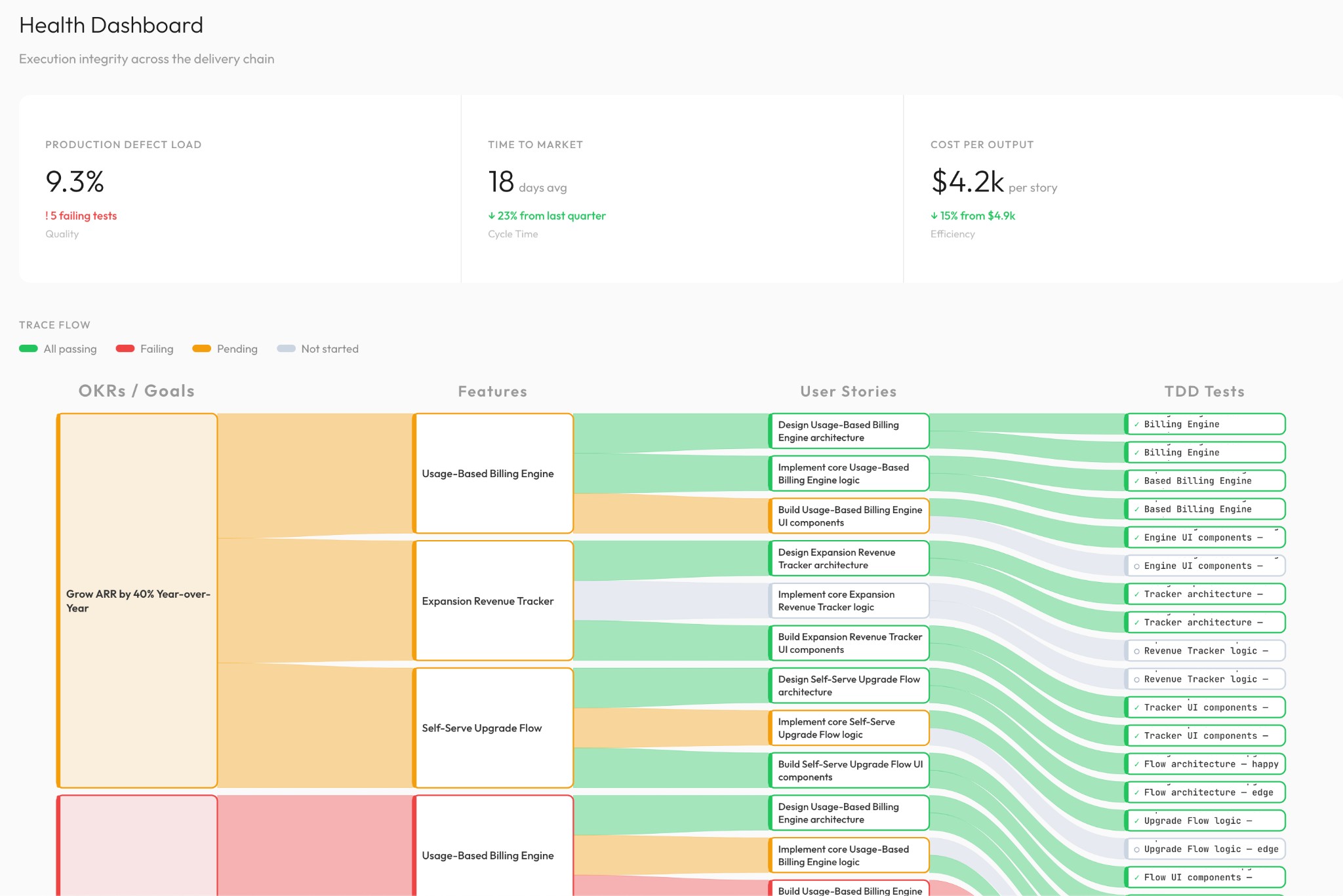
See everything. Miss nothing.
// HOW_IT_WORKS
Five steps. One system of proof.
Capture and structure business goals
Leadership inputs OKRs or defines new commitments. OMNI converts these into structured, measurable artifacts — objectives, success metrics, time horizons, constraints, and ownership.
Convert goals into delivery commitments
OMNI translates business commitments into portfolio-ready scope — epics, features, and initiatives explicitly tied back to outcomes. It translates and aligns, maintaining the boundaries leadership approved.
Maintain traceability across artifacts
Every artifact — features, stories, requirements, tests, deploy notes — links back to the originating business commitment. Unconnected artifacts are flagged as drift.
Verify shipping against intent
Shipping is not merely code complete — it is intent complete. Requirements alignment checks, test coverage mapped to outcome criteria, delivery gating rules, and evidence collection.
Measure impact after delivery
OMNI connects shipped work to business metrics and observes outcome movement over time. Which feature influenced which metric. Whether expectations were met.
// WHAT_PEOPLE_SAY
“I have searched high and low and there just aren't any good examples of tools that fill this. Really excited about this!”
Roy
Agile Thought Leader, Author
“I can see how powerful this is, especially with the data plug-ins.”
Jason
SVP Agile Executive
“Excited to use this internally myself and to manage client work. This can improve our ability to produce high quality code that is directly tied to business OKRs.”
Shad
Management Consultant
“I don't impress easily with AI tools, but OMNI stands out. It tackles real enterprise delivery pain by turning vague goals into clear, enforceable, traceable commitments — integrating seamlessly with our existing stack.”
Bruce
VP Engineering
// SHIP_WITH_CONFIDENCE
Product delivery as an accountable system.
Not in decks. Not in theory. In features, metrics, and outcomes.
Request Demo